FOOD IS ART: THE STORY BEHIND EVERY FUSION DISH AT KILO KITCHEN BALI
Some dishes you eat. Others make you stop for a second before taking the first bite.
Maybe it is the way the colours sit against each other. The unexpected ingredient you cannot quite place yet. The texture that changes halfway through a mouthful. Or simply the thought that someone, somewhere in the kitchen, considered every element before the plate arrived at your table.
That is where food begins to move beyond necessity. And perhaps, where it begins to become art.
Food is art is not simply a tagline, but a working philosophy at Kilo Kitchen Bali, one of Seminyak’s best fusion food restaurants built around exactly that idea. It shows up in how every step of the cooking process is treated as a decision. Technique. Creativity. Passion. None of those mean much on their own. The art happens when they’re combined, plated and set down in front of you.
This is what you’ll experience at Kilo, where you’re welcome to slow down and admire the plate before taking the first bite.

Food Is More Than Something to Eat At Kilo Seminyak
Food and art have crossed paths for much longer than the modern restaurant has existed.
Across centuries, food appeared in paintings, sculpture and symbolism. Food was used to represent abundance, sometimes celebration, mortality, or status and everyday life.
Then came the early twentieth century. The relationship changed. Avant-garde artists stopped treating food only as something to depict, they turned cooking and eating themselves into art.
Here at Kilo Kitchen, our approach to treating food as art starts long before a dish reaches the table.
It begins with ingredients. We seek freshness, character, texture and how they can work together without overwhelming each other. From there comes technique—the preparation, heat, seasoning, timing and dozens of small decisions that guests may never see.
Then comes interpretation.
As a fusion food in Bali, Kilo’s menu brings together Latin American and Asian influences, allowing familiar flavours and techniques from different culinary cultures to meet naturally rather than compete for attention. It is the foundation of what fine dining in Seminyak, Bali looks like at Kilo Kitchen Bali.
To us, fusion is not about adding as many influences as possible to one plate. It is about knowing what belongs together.
A dish should still make sense when you eat it. One ingredient might surprise you, but another gives you something familiar to return to. Richness needs freshness. Softness needs texture. And heat needs somewhere to settle.
The final presentation matters, certainly. But the beauty of a dish should never exist separately from the way it tastes.
The Opening Note: Wasabi Tuna Tartare
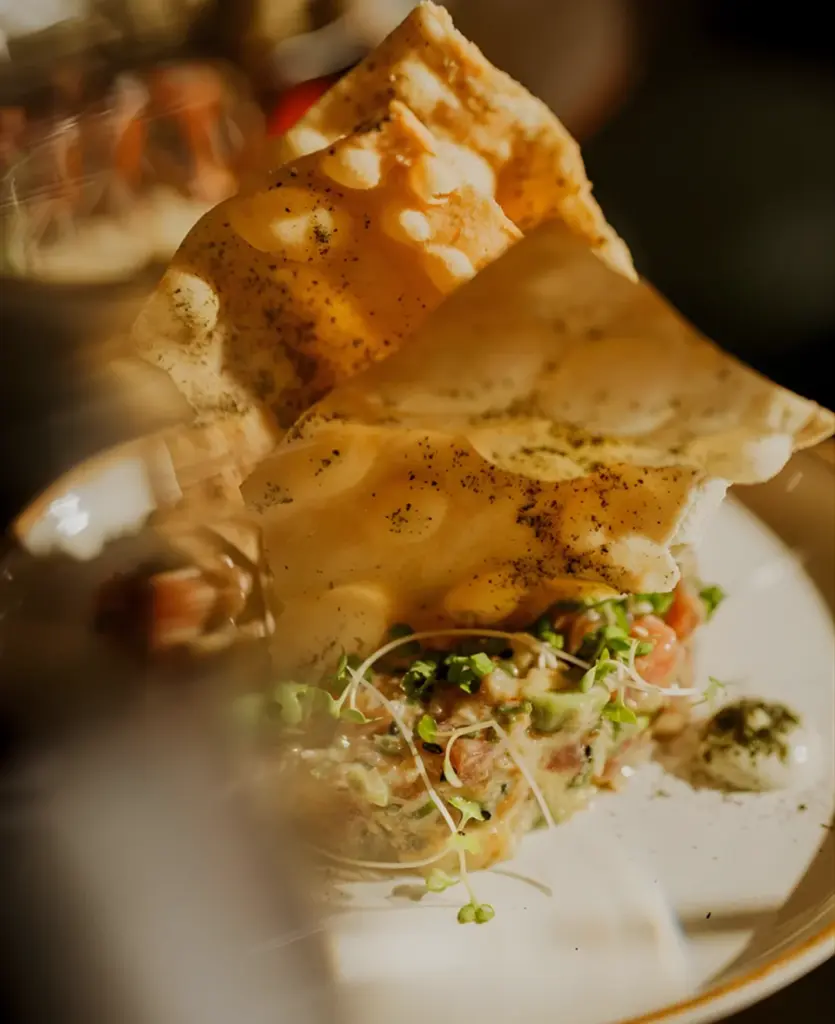
A good first course should open the appetite rather than satisfy it completely.
And that’s what our Wasabi Tuna Tartare brings to you. Tuna, wasabi, avocado and crispy flour chips form a concise composition in which every element has a clear purpose.
Tartare itself has an interesting journey. While the technique is historically associated with finely chopped raw preparations such as steak tartare, the seafood version is much more modern. Japanese-born, French-trained chef Shigefumi Tachibe is widely credited for creating tuna tartare in Los Angeles in 1984. Substituting beef with tuna and helping create a dish that would eventually become closely associated with contemporary fusion dining.
At Kilo, we take that meeting of culinary ideas in our own direction.
Fresh tuna forms the centre of the dish. Its clean flavour is met by the unmistakable lift of wasabi, while avocado introduces softness and richness without weighing the plate down. The flour chips provide the contrast of a crisp bite against the tenderness of the tuna and avocado.
Visually, the dish plays with the same principle. The natural red of the tuna sits against fresh green tones from the avocado and wasabi, punctuated by the pale, golden crispness of the chips.
It looks bright because it is meant to feel bright.
Think of Wasabi Tuna Tartare as the first glimpse of your meal. A clean, fresh and lightly provocative beginning intended to wake up the palate for what comes next.
The Centrepiece: Salmon Tuturuga
Then the meal begins to deepen with our Salmon Tuturuga.
This dish brings together salmon, corn quinoa urap and a Manado-style curry, served alongside furikake rice.
On paper, there is already plenty happening here. Indonesian tradition meets contemporary ingredients, Japanese seasoning finds its way onto rice, and salmon becomes the canvas that holds the composition together. Yet the intention is balance, not complexity.
Tuturuga belongs to the culinary traditions of North Sulawesi and is closely associated with Manado and Minahasan cooking, a cuisine celebrated for bold seasoning, seafood and generous use of herbs and spices. Traditional variations of this dish include chicken tuturuga, but at Kilo, the idea is reinterpreted around salmon instead.
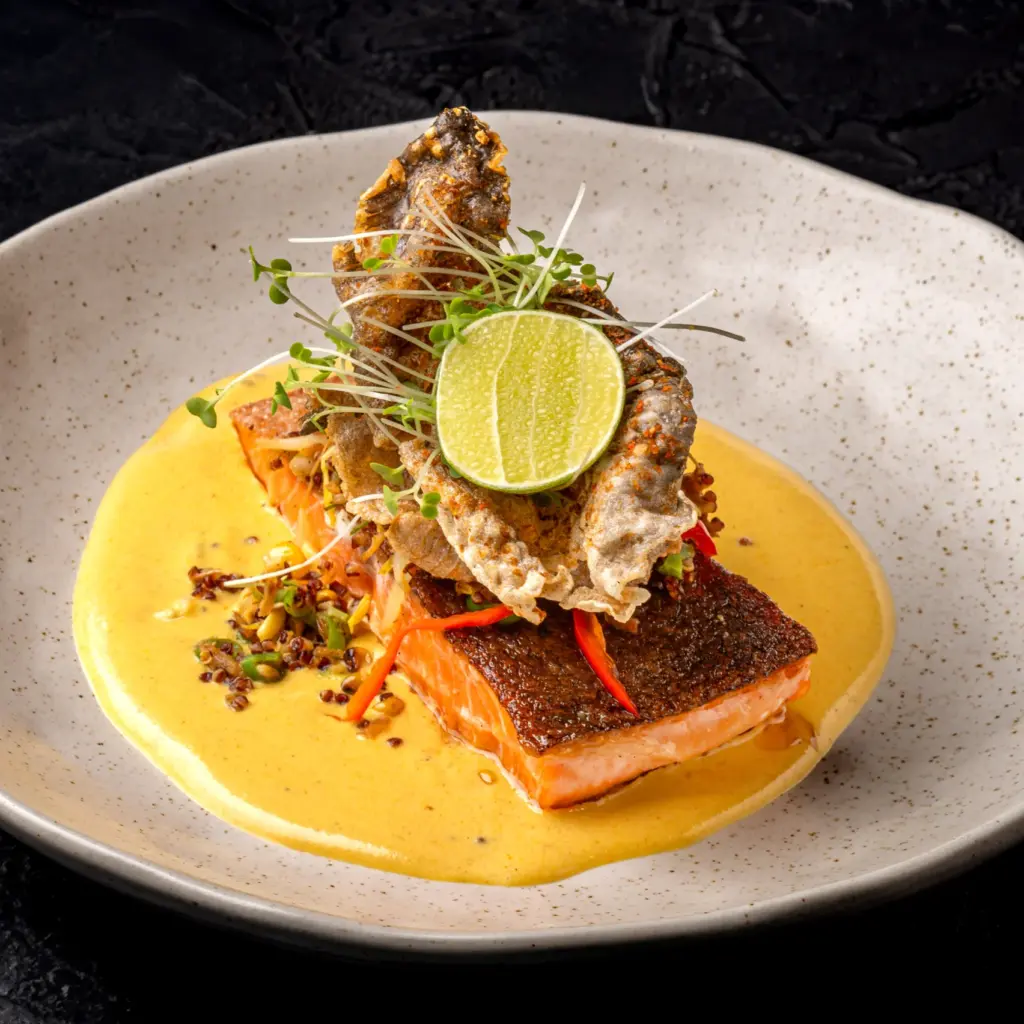
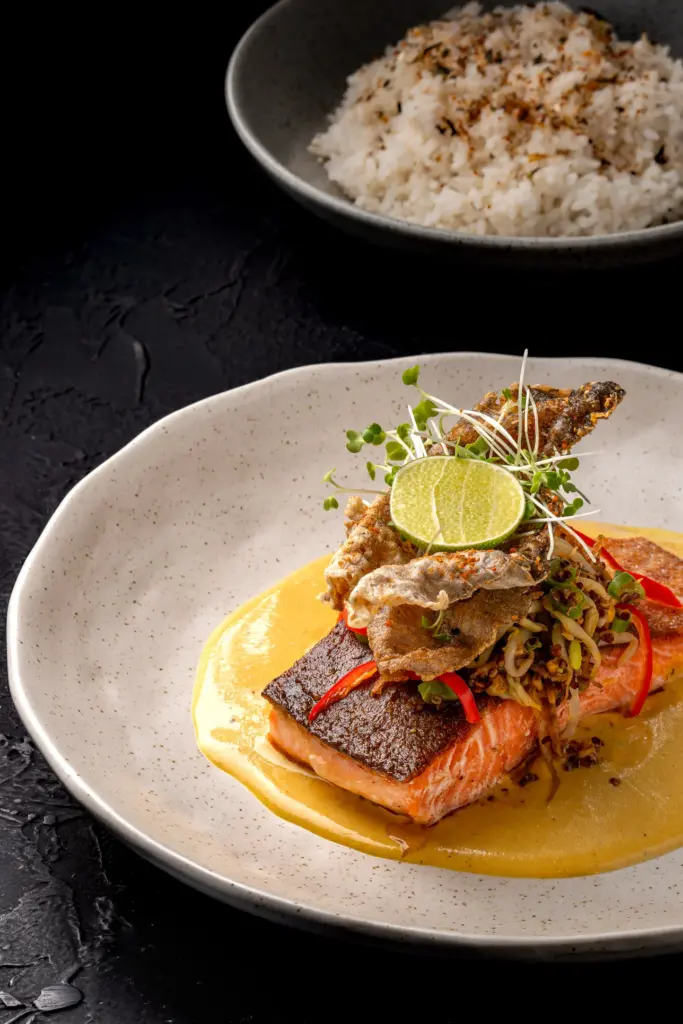
The Manado-style curry brings depth, warmth and spice to the plate. Fresh salmon provides richness and a tender centre against those aromatic flavours. Beside it, the corn quinoa urap introduces another layer.
Urap is rooted in Indonesian cooking, where vegetables are traditionally paired with seasoned coconut. In Kilo’s interpretation, corn and quinoa bring texture and a slightly more contemporary expression to that familiar idea.
Combined with furikake rice that gives the plate comfort and familiarity with its own Japanese accent. Together, these elements create a dish that travels across influences while still feeling complete rather than fragmented.
That is an important distinction in the way we think about fusion. Good fusion cooking should not make the diner work too hard to understand it.
The Salmon Tuturuga is a fitting introduction to Kilo’s signature approach for exactly that reason.
For guests discovering Kilo for the first time, it is a plate that communicates what a fusion restaurant in Seminyak can be when influences are allowed to complement each other rather than simply coexist.
A Final Composition: Pistachio Cake
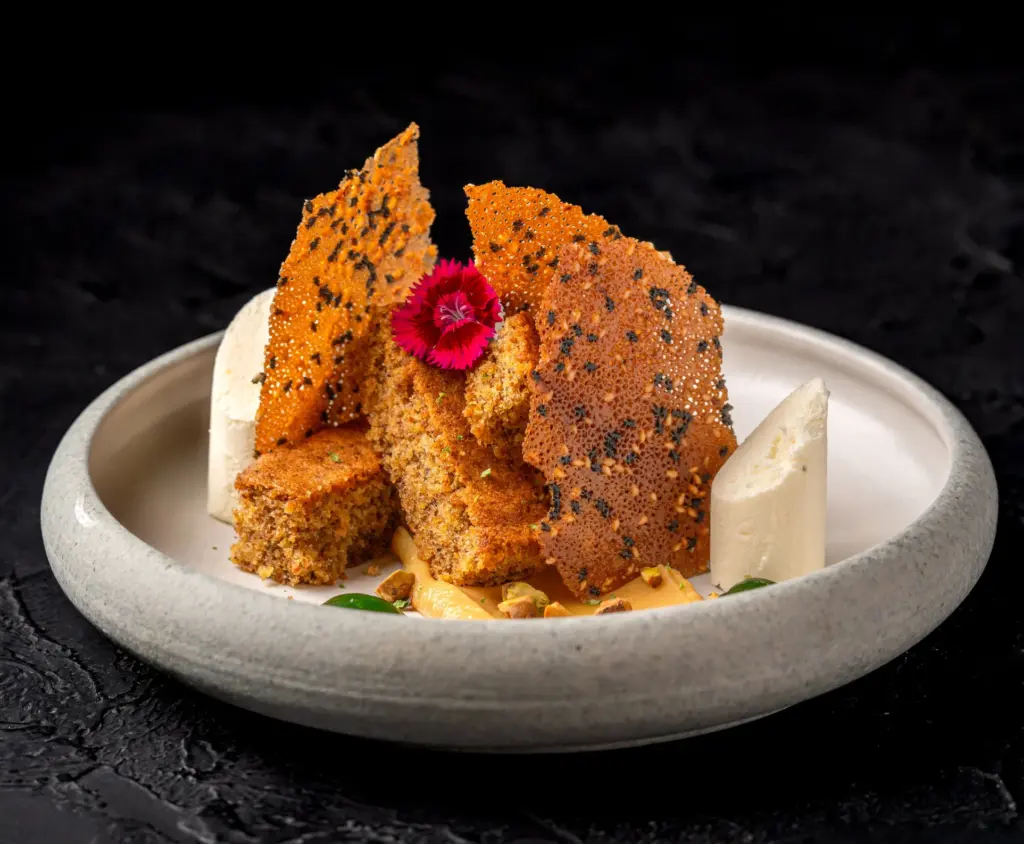
By the end of a meal, the palate has already travelled through acidity, spice, richness and texture. The final plate needs to feel indulgent enough to deserve its place, but thoughtful enough not to undo everything that came before it.
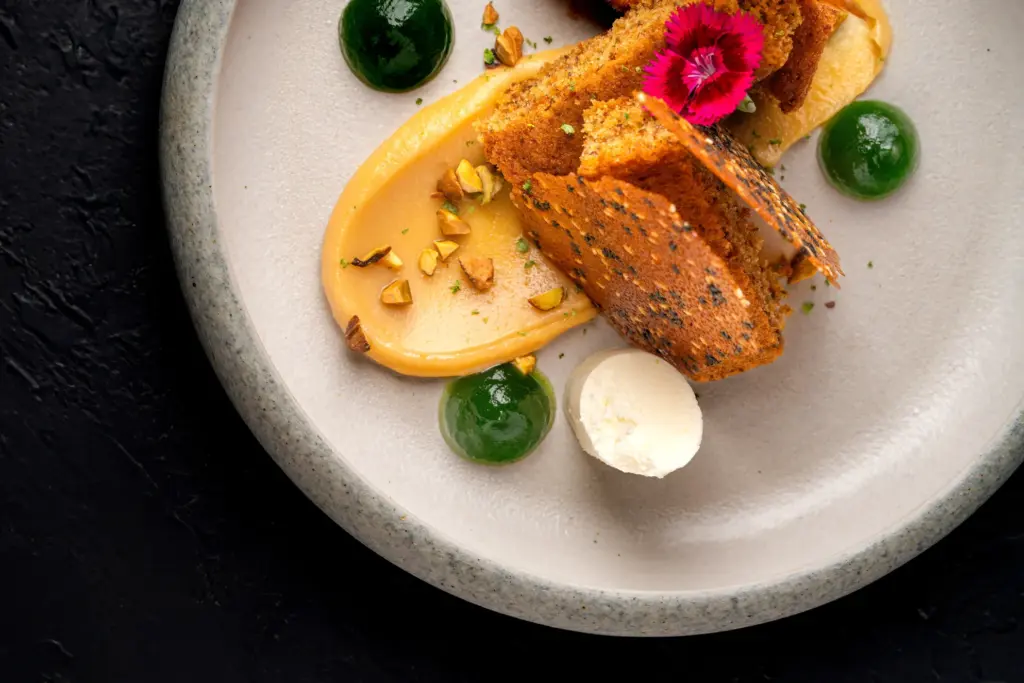
This is where our Pistachio Cake sits. This dessert pairs pistachio cake with parmesan custard, sesame crisp, lemon parfait and mint jelly.
The cake brings a soft and nutty foundation. Parmesan custard introduces an unexpected savoury character. Sesame crisp adds the texture that the softer components need. Then lemon parfait cuts through with brightness. And finally, mint jelly leaves a clean, refreshing note behind.
Each flavour has a different role, but the pleasure comes from experiencing them together.
Presentation follows the same philosophy. Rather than simply placing a slice of cake in the centre of a plate, each component becomes part of the composition. Different textures, shapes and tones invite you to move around the dessert rather than experience every bite in exactly the same way.
One spoonful might carry more lemon. Another more pistachio. The next may catch the parmesan custard with a piece of sesame crisp.
This makes your dessert something to explore.
After dinner, or after a long afternoon wandering through Seminyak, the Pistachio Cake offers a satisfying ending, but still light enough to leave you remembering the meal rather than recovering from it.
What to Know Before Your First Bite of Heaven
What kind of cuisine does Kilo Kitchen Bali serve?
Kilo Kitchen Bali serves fusion cuisine that blends Latin American and Asian influences, built around the idea that ingredients and techniques from different culinary cultures should complement rather than compete with each other.
What is Kilo’s signature tasting experience?
The article walks through three signature courses: the Wasabi Tuna Tartare to open, Salmon Tuturuga as the centrepiece, and Pistachio Cake to close, each designed to build on the course before it.
Is Kilo Kitchen Bali suitable for a fine dining experience in Seminyak?
Yes. Kilo is built around treating each dish as a considered composition, from ingredient selection through to final plating, positioning it among Seminyak’s fusion fine dining options rather than a casual dining spot.
Art Made to Be Eaten
When we say food is art at Kilo Kitchen Seminyak, we are not talking only about beautiful plating.
A beautiful plate is simply the part you get to see. The process is where much of the art actually lives.
Behind it are ingredients chosen with intention. Preparation carried out with care. Techniques learned, repeated and refined. Flavours tasted and adjusted until they reach the right balance.
And unlike a painting hanging quietly on a wall, food asks you to participate. You break the crisp. Mix the sauce. Find your favourite combination. Share a bite across the table. Taste something you did not expect.
Maybe that is part of what makes dining special.
At Kilo’s modern artistic venue, surrounded by the movement of Seminyak yet designed for guests to settle into the experience at their own pace, food is not created only to be looked at.
It is art made to be enjoyed.
And this is your official invitation to come and discover the art on the plate at Kilo Kitchen Bali yourself.
“Reach out to reserve a table” or “browse the full menu” to see the rest of what’s on the plate.

Milad Arsenius